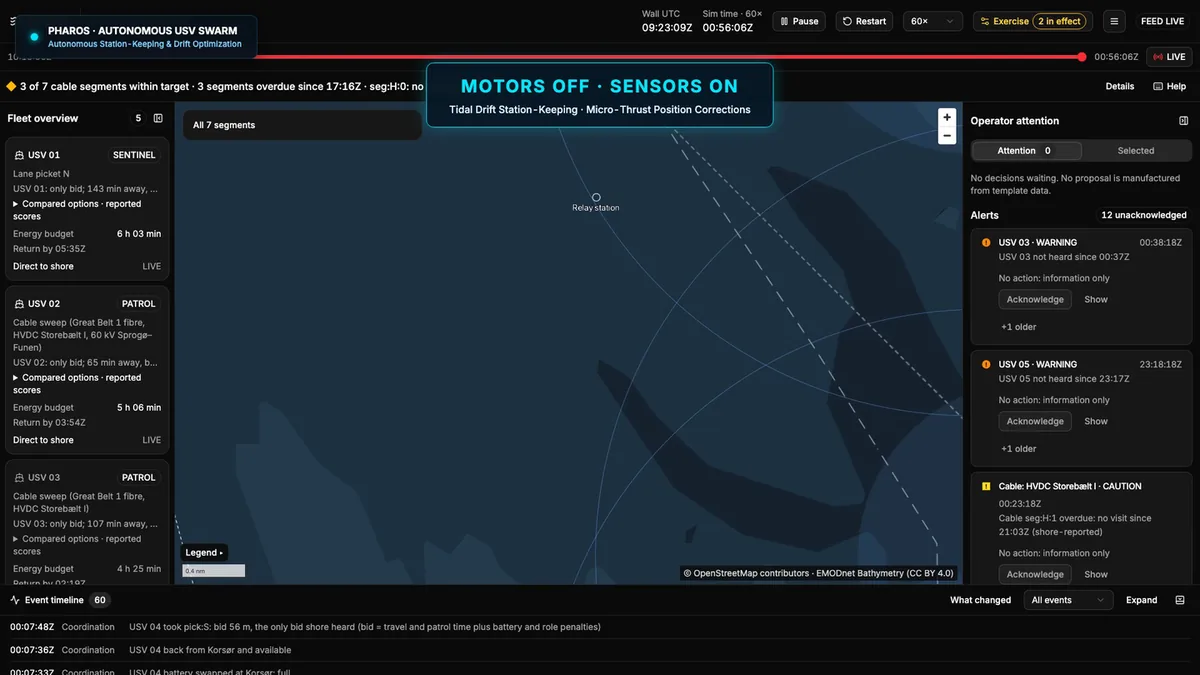
PHAROS
A swarm brain for small patrol boats that guard undersea cables, and the shore console that keeps one watch officer in charge. Built in one weekend at the European Defense Tech Hackathon in Copenhagen.
- Role
- Evaluation, map data, pitch script and slides, in a team of four
- When
- 6 to 8 November 2026, on site in Copenhagen
- Event
- European Defense Tech Hackathon (EDTH) Copenhagen 2026, 100+ hackers from across Europe. Challenge 07: Swarm Coordination for Collaborative Missions
- Result
- Pitched to the jury. Only the top three were announced, and the jury scored the three-minute pitch rather than the software
- Size
- 5 boat agents, 387 tests, 92 merged pull requests in one weekend
- Tools
- Links
- Code on GitHubTeam pageThe hackathon
The problem
Three power and data cables run under the Great Belt, one of the busiest shipping lanes in Danish waters. On Christmas Day 2024 the EstLink 2 cable in the Gulf of Finland failed, and it took hours before anyone reached the suspected ship by radio.
Small uncrewed boats can watch cables around the clock, but they fail in ordinary ways: a battery runs low, a radio link drops, a boat goes home. One watch officer covering a 25 by 10 km box cannot steer five boats by hand. The challenge was to let the boats coordinate themselves while a person stays in charge of what matters.
How it works
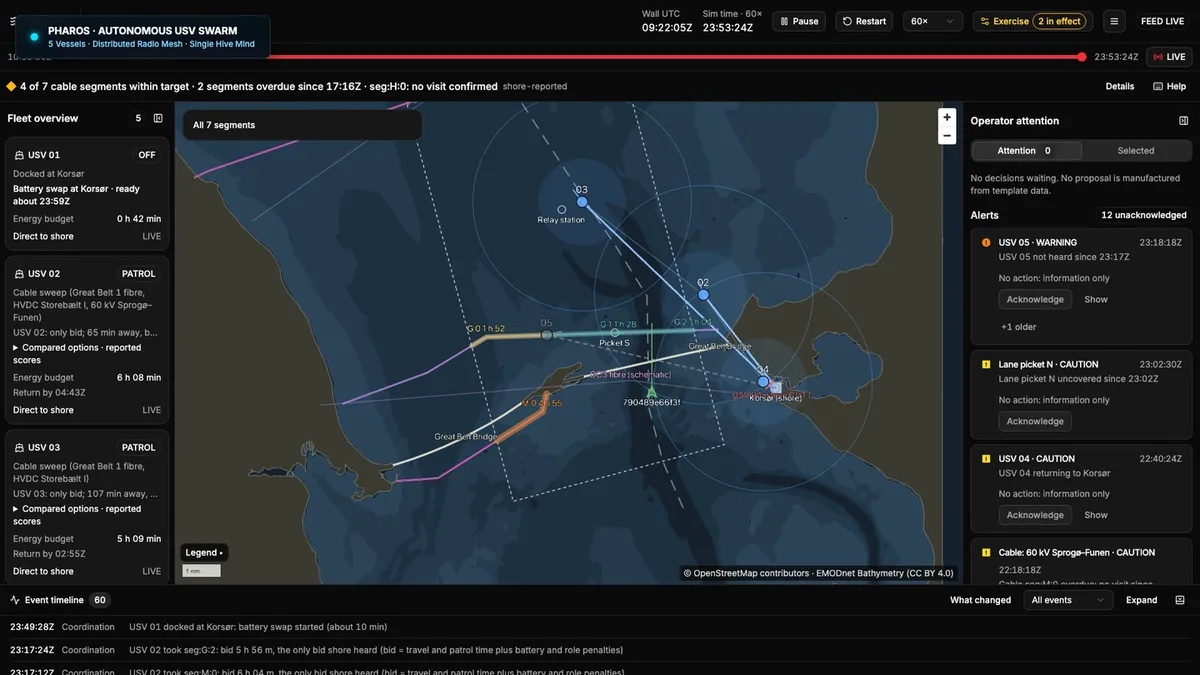
- No boat in charge: all five run the same code, share one task table over the radio and auction open work. The bid is a time: travel, the patrol loop with the task added, and a penalty for low battery.
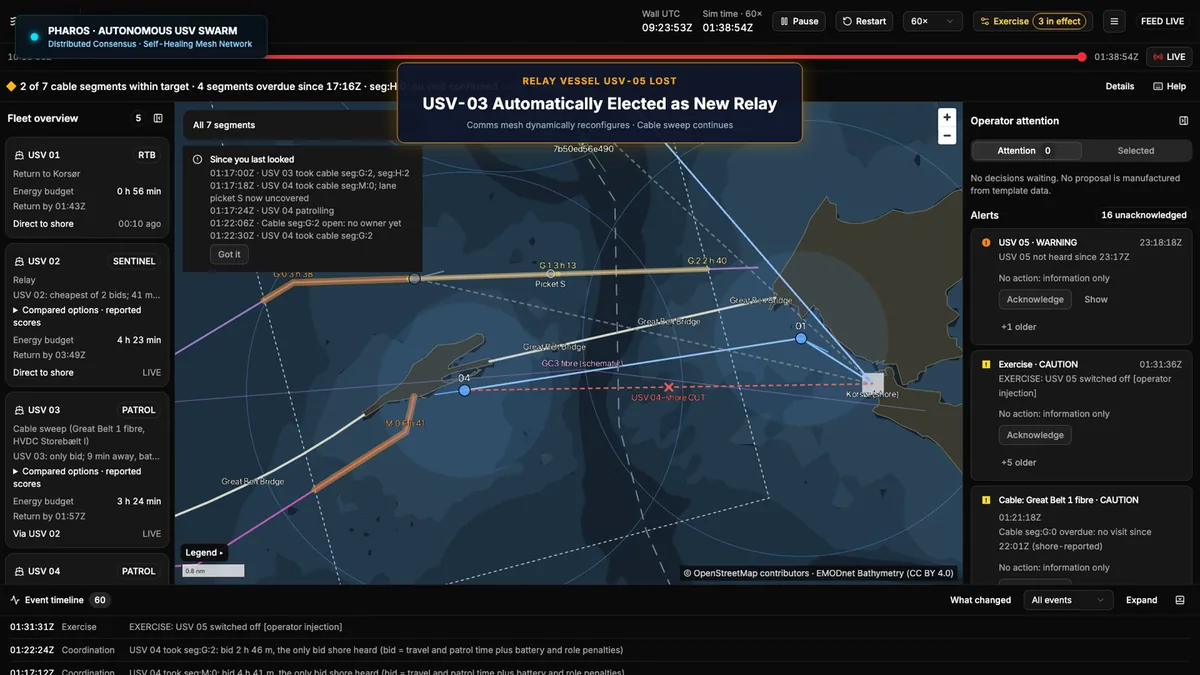
- It repairs itself: when a boat goes silent or returns to charge, its tasks reopen and the cheapest free boat takes them. If the relay boat is lost, another one becomes the relay.
- A person decides what matters: keeping a ship in view from a nautical mile away is pre-approved. Closing to 500 m for a look waits for the operator, and no answer means no action.
- It knows when to go home: each boat times its trip back against the current it measures, with a reserve, and never bids on work it could not finish and still get home.
- The real sea: the real Great Belt coastline, cables, shipping lane, seabed depth and tide, with a day of real ship traffic replayed.
What I developed
- The evaluator: it sees the ground truth, not what the shore was told, and scores every run. It records cable left unwatched, battery reserve, time to recover and real ship crossings in camera range.
- The paired scorecard: after a three-hour warm-up, a boat runs low, a radio link is cut and a dark contact appears. Three modes (fixed stations, repair switched off, and PHAROS) run on identical inputs over 30 seeds. With PHAROS, less cable was left unwatched in all 30, and no boat went below its battery reserve.
- The honest trade-off: repair moves a boat off its shipping-lane picket to the cables, so fewer real ship crossings stay in view. Five boats cannot cover everything; PHAROS chooses where the gap lands and shows it. We put that in the pitch instead of hiding it.
- The map data: the real coastline and the Great Belt Bridge, a Sentinel-2 satellite image of the box, and depth contours from the EMODnet seabed model.
- The pitch: the script, the slides and the operator guide, tested on people who had not seen the project.
The swarm agent was built by Javier Arevalo, the shore service and console by Alexandru Zaitzev, and the simulator and 3D view by Simeone, who joined the team for this hackathon.