Spreadbot
A bot that runs a car-transport company for one simulated week, live, against every other team. My challenge at Junction 2026, set by Bahn Express.
- Role
- My challenge. Javier Arévalo Hernández and I started it together; from Saturday morning I ran it, directing a team of Claude Code agents
- When
- 13 to 15 November 2026, on site in Espoo, Finland
- Event
- Junction 2026 in Espoo, Europe's biggest hackathon, with challenges set by Google DeepMind, OpenAI, Meta, NVIDIA, Intel, AstraZeneca, AfterQuery, Arduino and 20+ more companies. Challenge: Spread, by Bahn Express
- Result
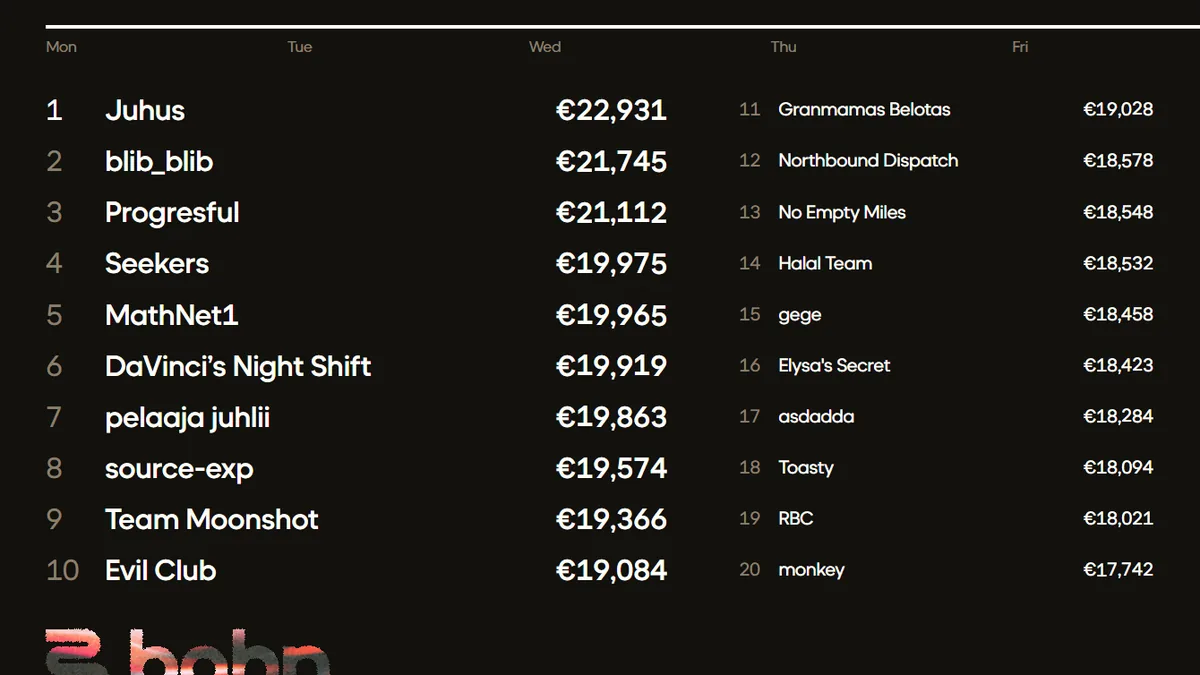
- 16th in the live final: €18,423 at 96.7% on time, €661 short of the top 10. Before that, 6th of 57 in a ranking round, and 9th of 75 and 4th of 41 in the two test finals
- Tools
- Links
- VideoCode on GitHub
Video
The problem
Bahn moves cars for car dealers, and a freelance driver drives each car on its own wheels. Spread is that work as a simulated week in Finland. A dealer asks us for a price and asks a hidden competitor too: quote too high and we lose the car. Each car we win is posted as a gig in the drivers' app, at a fee we choose: pay too little and no driver takes it in time.
The score is the margin, what dealers pay minus what drivers are paid, and at least 90% of cars must arrive on time. Every team plays the same week, live, on one leaderboard.
How it decides
- Quote: the price that maximises the chance of winning times the margin left after the fee and the late risk. The competitor's level is learned live, per day, dealer and lane.
- Late risk: gradient-boosted trees trained on 804,000 past orders predict whether a car will be late (held-out AUC 0.90), and the risk is priced into every quote.
- One fee per gig: read off a measured booking curve, anchored on the drive time, because drivers price the drive, not the list fee.
- Gigs that end near home: two cars are paired into one gig when it ends close to where drivers live; those get booked far more often.
- Guards for the bad week: no long drives after warnings, and a late barrier that makes an expected late car more expensive as the week's on-time share drops.
How I worked
I ran several Claude Code sessions in parallel, each on one idea, with handoffs written by Gemini and Gemma. Every idea sat behind a switch, so it could be measured with and without on the same simulated weeks, including weeks it was never tuned on. An idea was merged only if it won.
- Pricing the late risk: +€2,076 per week on 12 unseen weeks.
- Gigs that end near home: +€400 to €600 per week on two unseen sets.
- One fee per gig from the booking curve: +€383 and +€541 per week on two unseen sets.
- The guards cost about €300 per week, but all 72 unseen weeks stayed above 90% on time.
- What lost: cheaper prices to win more cars, a looser late barrier, direct offers to drivers, three- and four-car gigs.
The final
We were 6th going into the last game-day. Then the other teams booked €1,500 to €2,000 each on their last-day cars. Our bot had a guard that holds those cars back to protect the on-time share in risky weeks, so it had little left to book.
We finished 16th with €18,423, our best live week, at 96.7% on time with every car delivered. Places 4 to 16 were within €1,550; we were €661 short of the top 10, who went on to the jury. A safety margin is a bet: in risky weeks it saved us, and in this one it cost us the jury.
Back to Junction 2026 Video on YouTube Code on GitHub
Our other Junction 2026 projects: OnCall · SuoKuulo · FocusLens